


In most cases, a door that creaks only takes around ten minutes to sort. You might even have the materials already in your house. Here’s how to fix a squeaky door properly and how to tell when the squeak is trying to tell you something bigger.
Why your door squeaks – By double glazed panel door experts
No matter whether you have a panel door or a French door. In nearly all cases, the annoying noise comes from the hinges.
A door hinge has two interlocking moving parts or plates (called leaves or knuckles) connected by a metal pin. When that pin moves smoothly inside the barrel of the hinge, the door opens and closes without a peep. But when something interferes with that smooth movement, you get the squeak.
Before you reach for the lubricant, it’s worth figuring out which hinge is the problem.
Have someone slowly open and close the door while you move your ear along each hinge. The squeaky one will make itself obvious.
The usual culprits for squeaky doors are:
Lack of lubrication
Hinges are lubricated during manufacturing, but that lubrication wears off over time. Once metal starts grinding on metal, the noise begins.
To prevent this problem make sure to remember to apply a drop of silicone spray or lithium grease to each hinge once or twice a year.
Dust and dirt
Grime works its way into the hinge barrel over the years, creating friction that results in squeaking doors.
Remember to wipe down hinges when you are cleaning the doors to stop the dust and grime from building up.
Rust or corrosion
Older hinges, especially in damp rooms like kitchens and bathrooms, can develop surface rust that causes stiffness and squeaking.
Again, this can be prevented by using a lubricant a few times a year.
Loose screws
If the hinge screws have worked loose, the whole hinge moves slightly every time the door swings, creating noise and wear.
Tighten hinge screws every six months. They work loose gradually, and a quick check with a screwdriver prevents problems before they start.
Quick Fix : Lubricate the squeaky door hinge
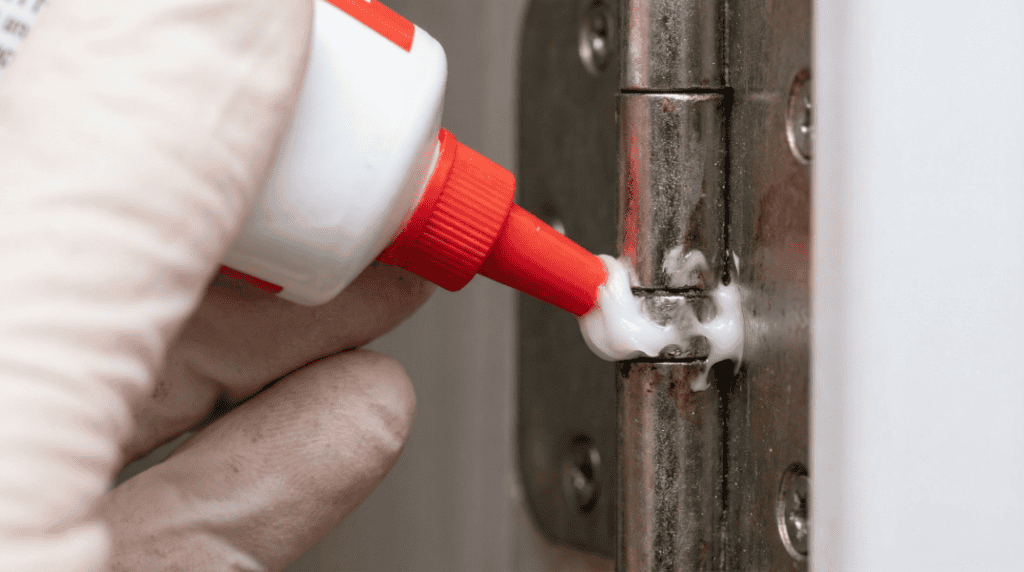
After visual inspection, if the hinges aren’t visibly rusty or damaged, a quick spray of lubricant is often all you need to fix a squeaky door hinge.
First, open the door so you can access the hinges easily. You may want to place an old towel or some newspaper on the floor underneath to catch drips.
Apply your lubricant to the top of each hinge pin where it meets the barrel. If you’re using a spray, use the straw attachment for precision and keep it about an inch from the hinge.
Slowly swing the door back and forth a few times to work the lubricant into the hinge. Before finally wiping away any excess with a cloth.
Lubricant should work almost immediately after application.
Test the door. If the squeak has gone, you have successfully solved the issue.
Thorough fix: remove and clean the hinge pins
Door still squeaking? Not to worry. Sometimes all they need is a thorough clean.
You may need to remove the hinge pins and give them a proper clean. Although this sounds complicated, the whole process shouldn’t take longer than half an hour.
First, close the door and keep it stable by wedging a folded towel underneath.
Next, starting with the bottom hinge, place the tip of a nail against the underside of the hinge pin and tap it gently upward with the hammer. Once the pin pokes out the top, pull it free by hand or with pliers.
Deep clean the pin with steel wool to remove rust and dirt. Then, coat the pin evenly with lubricant before sliding it back in place. You may need to tap it gently back in position with a hammer.
Repeat for every squeaky hinge.
Open and close the door several times to distribute the lubricant evenly.
An important word of caution: only treat one hinge at a time. Taking out all the pins at once will cause the door to come out of the frame, which can be tough to reinsert.
What’s the best lubricant for door hinges?
Not all lubricants are created equal, and some tools and materials are better than others for solving squeaking sounds.
White lithium grease
Heavy duty. Water resistant. Heat resistant. Long lasting.
White lithium grease is the gold standard for door hinges. Best of all, it won’t drip down your door frame when you apply it.
You can easily buy white lithium grease from hardware shops or online, and a single application should help keep your hinges quiet for a year or even more!
Silicone spray
Quick to dry and a great all-rounder, silicone spray goes on wet and dries into a slippery lubricant that doesn’t attract dust to keep your hinges clean.
The cans are cheap and long lasting, and can also be found in most hardware shops.
Petroleum jelly (Vaseline)
Petroleum jelly isn’t just for your dry lips, it can also be used to coat your dry door hinges.
Simply coat the hinge pin in a thin layer before sliding it back in.
It is cheap, lasting, and you might not even need to pop out to the shops to get it!
WD-40
Here’s the thing many people don’t know about WD-40. It’s not actually a lubricant.
It’s a water displacement formula designed to protect against corrosion. This makes it better at
Although it can stop a squeaky temporarily because it displaces moisture and grime, the effect wears off in a few weeks when it evaporates. For a lasting way to fix a door squeak, use one of the options above. WD-40 is useful as a first step for freeing a seized hinge pin, but follow it up with a proper lubricant.
It’s not always squeaky hinges causing creaky doors
Unfortunately, it isn’t always the hinges that are the cause of a squeaky door.
Wood swelling
Because Scotland is surrounded by the sea, we tend to have a wet and humid climate. If your doors are wooden, they absorb moisture from air over time, which can cause them to expand. This can cause them to rub against the frame or the floor to cause that annoying creek.
The door may improve when the weather gets drier, or sometimes sanding the edge that is rubbing can help. However, persistent squeaks or heavy warping may need a replacement door.
Misaligned frame
Sometimes door frames can shift out of place, causing it to catch or rub in ways that produce the annoying squeak. Adjusting the hinges or the striking plate can fix this.
But if it is your home’s settlement that has caused the misaligned frame, you may need to restore the whole frame.
Worn-out hinges
Door hinges don’t last forever. On average, they need to be replaced every 10 to 15 years. Although regular maintenance from lubricant and WD-40 can help hinges last up to 25 years!
If the pin is visibly bent, the knuckles are sloppy, or the hinge has been painted over multiple times, no amount of lubricant will fix the underlying wear and replacement is the only option.
Thankfully, new hinges shouldn’t set you back more than a few pounds for internal doors and less than £30 for external doors.
When it’s time to replace the door
A squeaky hinge is a ten-minute fix. But sometimes the squeak is just the most obvious symptom of a door that’s past its best. Here are some signs that repair isn’t worth the effort anymore:
- Persistent draughts around the edges, even when the door is fully closed
- Visible gaps between the door and frame
- Difficulty locking or the door not sitting properly in the frame
- Condensation forming between double-glazed panels (if it’s a glazed door)
- Rotting or warping in wooden doors that keeps coming back after repair
- Poor security from outdated locks or a flimsy door panel
Here at The Advanced Group, we specialise in modern exterior doors. We offer composite doors and uPVC doors due to their insulation properties and protection against warping, which is common for Scottish homes.
If your doors are showing any of the above signs, get in touch with our team of experts, and we can walk you through the replacement process and find a style that suits your home. We can also measure your replacement door to find the perfect fit.
Best of all, all our doors comes with a 15-year guarantee so you can feel confident that you are getting the highest quality of uPVC and composite doors on the market.
To learn more about our services, contact The Advanced Group today on 01355 271 223 (Glasgow) or 0131 370 0444 (Edinburgh).
