


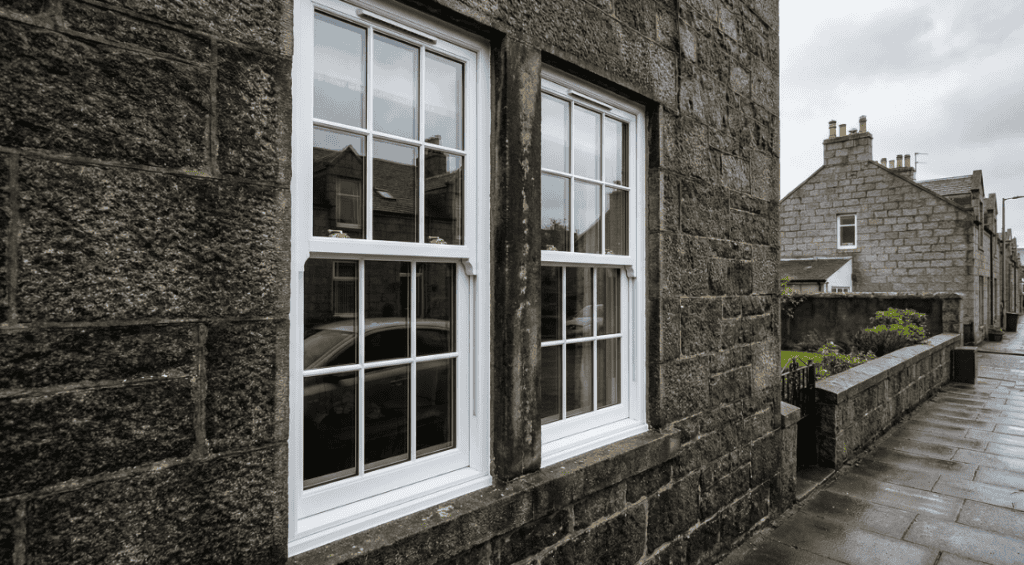
Sash windows aren’t only a period feature. The sliding mechanism does something a hinged window physically can’t, and that ventilation trick is the focus of this guide as much as the history.
What is a sliding sash window? – By Dundee’s double glazing experts
A sash window uses two movable panels, the upper sash and the lower sash, that slide up and down within a fixed outer frame rather than swinging outward on a hinge.
Traditional sash windows counterbalance each sash with weights on a cord, running over a pulley inside the frame.
Both the top and bottom sashes open and close independently, which means each one can sit at a different height at the same time.
Modern uPVC (polyvinyl chloride) sash windows replace that weight-and-cord system with a spiral balance mechanism built into the frame itself.
You get the same smooth vertical slide and the window holds at any height, without the cords that snap on an old timber frame after a few decades.
Ventilation without compromising security
Drop the top sash down an inch and warm, stale air rises out through the gap. Raise the bottom sash the same amount and cool air draws in underneath it.
Run both together and you get a slow convection current through the room, all without opening the window wide enough for anyone to climb through.
A sash window gets you fresh air without that trade-off, background ventilation you can leave running while the window stays effectively closed.
We’ve heard it called Victorian air conditioning.
A safer way to ventilate overnight
Keeping the bottom sash closed and dropping only the top by an inch is also the safer option overnight, since it rules out anyone reaching the catch from outside.
That background air circulation earns its keep in a bedroom overnight, or a kitchen after cooking, when a sealed room’s indoor air quality drops fast.
A sash window solves that without leaving the house exposed while you sleep, which a fully open casement can’t manage.
Energy efficiency in a modern uPVC sash window
Original single glazed timber sash windows lose heat fast, and the gaps around the meeting rail and the sash cords let draughts through on top of that.
Modern sash windows fix both problems at once, and better insulation is the main reason we get called out to replace them.
Our standard double glazed uPVC sash windows are A-rated and hit 1.4 W/m²K, meeting Scottish Building Regulations exactly rather than scraping past them.
That figure can be tightened to 1.2 W/m²K on request.
What the improvement saves
Triple glazing goes further still, reaching 0.8 W/m²K across the whole window with a Soft Coat Xtra coating and argon gas fill between the panes.
Reducing energy loss through the glass this much shows up directly in energy costs over a Scottish winter, particularly in a period property that was never built with cavity wall insulation to fall back on.
Double-glazed sash windows are a form of insulated glazing, and swapping out single glazing for it cuts heat loss through that window specifically, pane by pane as each one gets replaced.
A period look that complements a modern home too
Sash horns at the corners of the lower sash, and Georgian bars dividing the pane where the original had them, are both standard details we replicate in the uPVC replacement.
From the street, a well-measured uPVC sash window is difficult to tell apart from a timber original in good condition. The aesthetic appeal of the original stays intact, right down to the proportions.
The same slim proportions and vertical emphasis complement a newer build’s architectural style too.
A sash window stands out on a street built with casement as standard.
Tenement flats, Georgian townhouses, and modern builds each carry the style differently, but the proportions work on all three.
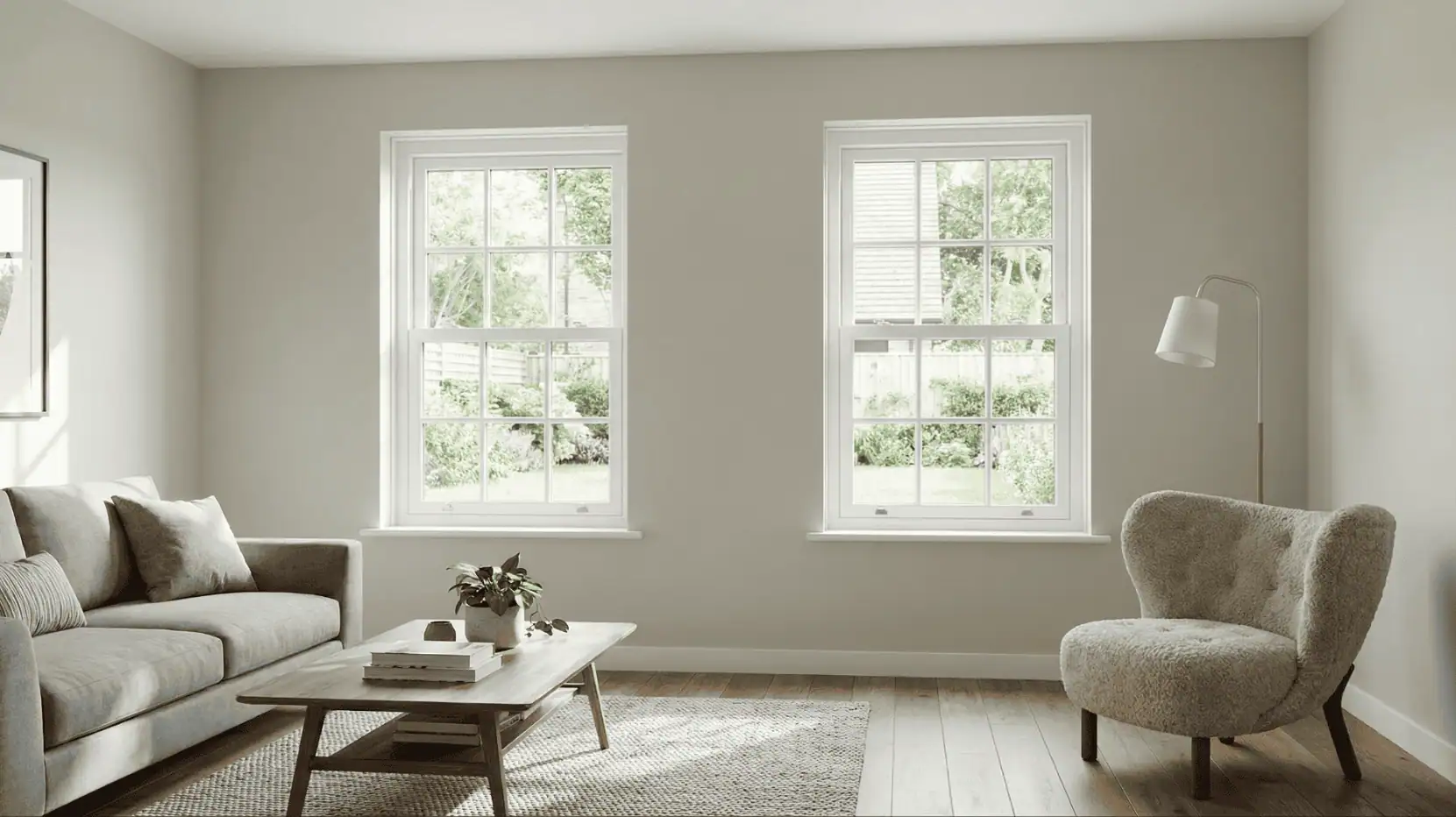
Sash windows vs casement windows
Neither type of window is simply better.
A casement window opens fully for maximum airflow when you want it, seals slightly tighter when closed since the sash overlaps the frame, and usually costs less to manufacture.
A sash window trades some of that ventilation-on-demand for background air circulation you can leave running safely, plus the period proportions a casement can’t replicate.
Conservation area status and planning conditions decide it for a lot of period properties, since a conservation area will often specify sash for a front elevation.
On a modern estate with no such condition attached, casement is the standard fit.
Durability and low maintenance uPVC
Timber sash windows need repainting every few years, and the bottom rails rot first wherever water collects on the sill.
uPVC doesn’t rot, warp, or need a paint cycle, and the spiral balance mechanism is sealed inside the frame rather than exposed to the weather.
A homeowner replacing box sash windows for the first time is dealing with that maintenance cycle directly, often after a cord has already snapped and left a sash stuck.
Around 80% of the uPVC we use is recycled or renewable, sourced through our partnership with Camden in Ireland.
You get a lower-maintenance window without the trade-off being a virgin plastic product with nowhere to go at the end of its life.
What sash windows cost
Sash windows offer real advantages over a standard casement, and the trade-off is cost: the spiral balance mechanism and the box frame construction are both more complex to manufacture than a simple hinge.
Size, glazing specification, and finish colour all move the price too.
Rather than quote a figure that won’t match your property, we survey first and follow up with a detailed written quote, so you know exactly what you’re paying before committing to anything.
0% finance is available with no deposit required.
Benefits of sash windows: your questions answered
What are the downsides of sash windows?
Cost is the main one, since sash windows require more complex manufacturing than a standard casement. Original timber windows also carry a maintenance cycle uPVC avoids entirely.
Sash windows often need a specific spiral balance size to match the sash weight. We measure that at survey rather than working from a standard chart.
Neither point is a reason to rule sash out, but they’re worth knowing before you choose sash over casement purely on looks.
Are sash windows worth it?
For a period property, or anyone who wants the ventilation a casement can’t provide, yes. A uPVC sash window gives you that without the upkeep a timber original demands.
Are uPVC sash windows suitable for period properties?
The sash horns, Georgian bars, and slim sightlines all replicate the original closely. Every council sets its own conservation area rules, so we check the specific planning position for your property during the free survey rather than assume.
Get your free quote from The Advanced Group
Whether you’re replacing a full house of original timber sash windows or adding sash to a single room for the ventilation, our free home survey covers both.
Call our Glasgow showroom on 01355 271 223 or request a free quote online.
Every installation carries a 15-year guarantee, and we survey and manufacture every opening individually rather than working from a standard size.
