


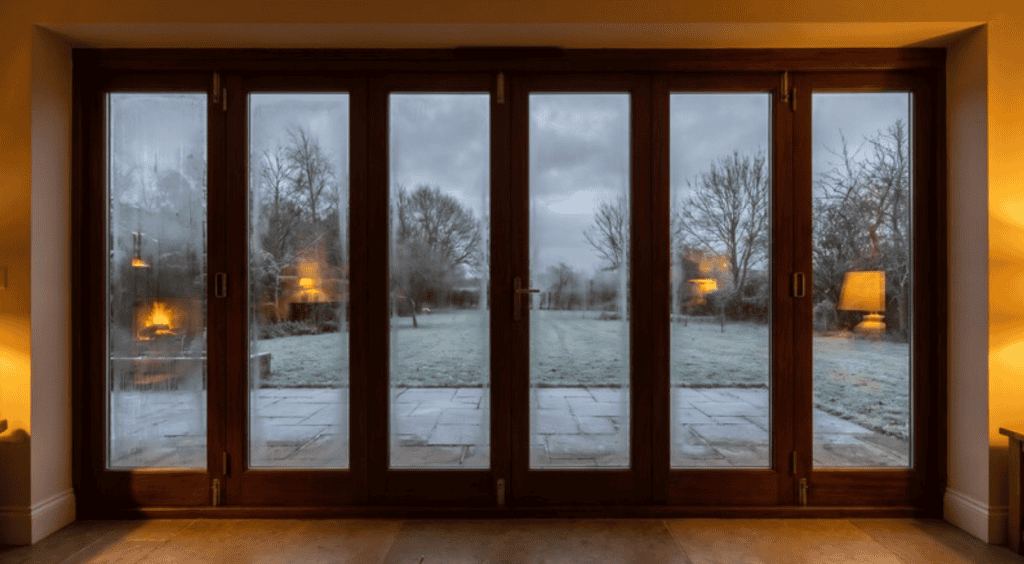
Why Condensation Forms on Bifold Doors – By Edinburgh Bifold Door Professionals
Condensation occurs when warm, moist air inside your home meets a cold surface. Water vapour in the warm air hits its dew point on contact with the colder surface and converts to liquid.
Everyday activities like cooking, bathing, and drying clothes indoors all put water vapour into the air.
In the colder months, when doors and windows are shut, that moisture accumulates faster than it disperses.
Older aluminium frames were particularly susceptible to condensation because aluminium transfers heat readily, allowing cold from outside to travel through the frame and chill the inner face. That cold inner surface then becomes the trigger for condensation when warm, humid room air touches it.
Modern aluminium bi-fold doors address this with a thermal break, which interrupts the heat transfer path through the frame and significantly reduces the risk of frame condensation.
In identical conditions, a thermally broken frame performs considerably better than an untreated one, though uPVC retains a natural advantage due to its inherently low conductivity.
In practice then, condensation on bi-fold doors is most likely to appear during winter months. Particularly in the early morning before the heating comes on, and most often at frame edges and junctions rather than across the face of the frame
Is Condensation on Bifold Doors Normal?
Frame condensation on bifold doors is normal in high-humidity or low-ventilation conditions. This is regardless of whether the frame is uPVC, aluminium or timber.
If you regularly experience condensation on the frame during cold weather, you’re not necessarily looking at a faulty door.
Many households get condensation on their bifolds in the same way they get it on aluminium windows elsewhere in the house.
Condensation inside the glass, between the panes, is different.
Moisture appearing inside the sealed glazing unit means the seal has failed, and cold air has entered the cavity. That’s a glazing fault rather than a humidity issue.
The two types look similar from a distance, but internal condensation between the panes won’t clear as the room warms up, while frame and surface condensation usually does.
External vs Internal Condensation on Bifold Doors
Not all condensation is equal, especially in the case of external and internal condensation.
External Condensation
External condensation forms on the outer surface of the glass panels and frame.
It happens when the outside of the glazed doors is colder than the dew point of the outdoor air and clears quickly as the morning warms.
External condensation on bifold doors actually indicates that the double glazed unit is working fantastically! This shows the warmth is staying inside rather than conducting through to the outer pane.
Internal Condensation
Internal condensation forms on the inner surfaces of the door, facing into your living space.
This type is driven by indoor humidity and ventilation.
If you’re getting condensation inside your home only on the bifold door frame and not on other surfaces, the aluminium frame is likely the coldest surface in the room.
Managing condensation of this kind means addressing the humidity level and airflow in the room rather than anything mechanical with the door itself.

How to Reduce Condensation on Aluminium Bifold Doors
The most effective ways to stop condensation on aluminium bifold doors target the two variables: indoor humidity and surface temperature.
Reduce one or raise the other, and it helps prevent condensation from forming.
Ventilation
Using extractor fans consistently in the kitchen removes moisture at the source before it spreads through the rest of the house.
Even leaving a trickle vent slightly open in the room where the bifold doors sit will help keep air inside moving.
Good ventilation is the single most effective long-term solution for managing condensation in any property. Without it, even energy-efficient doors and windows will collect moisture in a home with high internal humidity.
Using a dehumidifier
A dehumidifier running in the main room will pull excess moisture directly from the air inside.
Using a dehumidifier beside the bifold doors for a week or two confirms quickly whether the condensation is a humidity problem or a door problem.
If it stops forming on the frame once the dehumidifier is running, the door is fine and the room needs better ventilation as a permanent fix.
Reducing moisture at source
Everyday activities like cooking with uncovered pots generate significant amounts of water vapour.
Drying clothes indoors is another major source of moisture, particularly on drying racks near radiators in a closed room.
Moving drying to a ventilated space and covering pots while cooking, all reduce the moisture that ends up in the air.
Ultimately, this helps lower the condensation on your cold aluminium bifold door frame.
When to Call Your Installer
If condensation inside the glass is persistent and doesn’t clear when the room warms up, the sealed glazing unit may have failed and needs replacing.
Check the guarantee documentation from your original installation, as a failed seal on a new bifold door frame is typically covered.
If the aluminium frame is cold to the touch on the inside face during winter, and condensation persists despite good ventilation, a qualified installer can inspect the door.
They can check the thermal break and confirm the frame seals are intact. They can also assess whether the door is closing correctly against the frame on all sides.
Regular cleaning and maintenance of the track, hinges, and perimeter seals helps the door close properly. This matters for both energy efficiency and condensation management in the colder months.
Bifold Doors from The Advanced Group
Get modern and energy-efficient bifold doors from Scotland’s leading supplier of thermally efficient home improvements.
Our products stand against the tests of time, and backed by our 15-year guarantee you can feel confident in your home’s upgrade!
Whether you are looking for uPVC or aluminium bifold door frames, we have an unbeatable product selection in a huge range of configurations.
Book your free home survey today or contact our Edinburgh team on 0131 370 0444 to learn more.
