


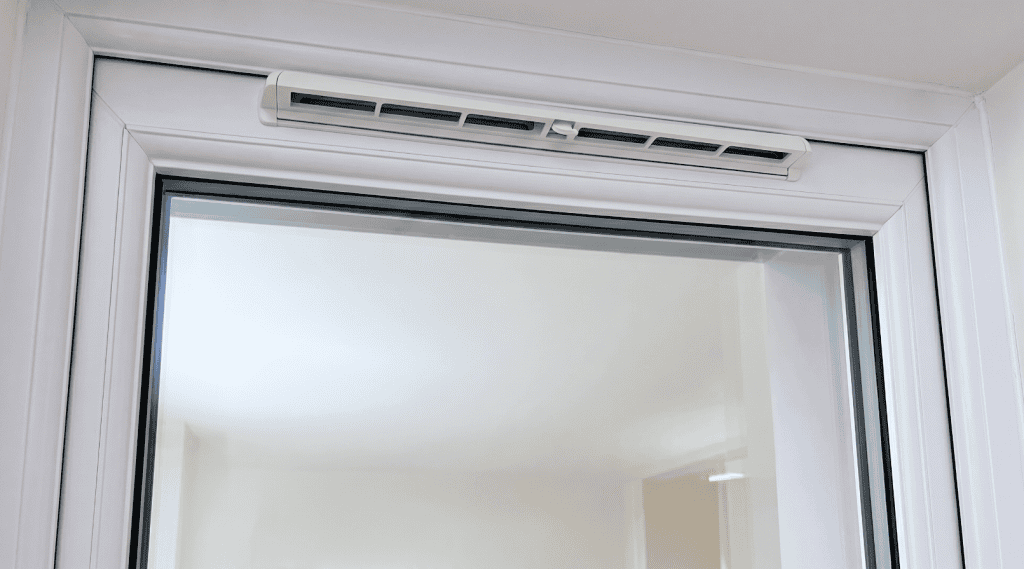
If you’ve had quotes for new replacement windows recently, trickle vents have likely come up. Building regulations in Scotland now require them on most new window installations, and installers are obliged to include vents where the regulations demand it.
This guide covers what trickle vents are, how they work, the main types, what the rules say for Scottish homes, and the practical questions that come up most often.
How do trickle vents work? – By double glazing professionals
Trickle vents provide background ventilation through a narrow slot or grille at the head of the window frame. The pressure difference between inside and outside drives a continuous flow of air through the opening, even when windows are closed.
Most modern trickle vents have a sliding cover or flap that lets you open or close the vent manually.
When the vent is open, fresh air enters and stale air finds its way out through other natural gaps in the building.
Closing the vent stops that airflow, which is useful in very noisy or very cold conditions, but it shouldn’t be the default position.
Vents for windows sit in the frame profile rather than the glass unit.
In uPVC windows, they’re built into the top of the frame during installation. In timber windows and doors, they may be routed through the frame or fitted as surface-mounted units.
Vents look like a narrow strip or grille across the top of the frame, usually colour-matched to the profile.
What are the main types of trickle vents?
Several types of trickle vents are available.
Vents or trickle ventilators fitted to windows and doors vary in design depending on the application and the level of acoustic or thermal performance needed.
Standard trickle vents
Standard trickle vents are the most widely fitted type, sitting on the surface of the window frame or in a slot cut through it, with a simple sliding cover to open or close the vent.
Most new windows and doors in Scotland include standard trickle vents where building regulations require them.
Vents are available in white, brown, grey, and other colours to match frame finishes.
Acoustic trickle vents
Acoustic trickle vents are specially designed for properties where sound reduction matters.
Standard window vents allow airflow but also let external sound in, which can be an issue on busy roads or near railway lines.
Acoustic vents use internal baffles to reduce noise transmission through the vent while still providing adequate ventilation. They cost a little more than standard vents but are worth specifying where external noise is a factor.
Acoustic trickle vents are available in the same frame sizes as standard vents. They can be factory-integrated during window installation or retrofitted to existing windows where the frame profile allows.
Passive trickle vents
Passive trickle vents rely entirely on natural airflow, with no motor or electricity involved.
Ventilators in windows of this type open and close in response to air pressure differences, providing consistent ventilation without any mechanical ventilation system.
Night vents
A night vent is a related but different product.
Some window designs include a night vent position where the window can be locked slightly ajar for ventilation while remaining secure.
Trickle ventilators in windows are separate openings in the frame. A night vent opens the window slightly to provide ventilation. A trickle vent does the same with the window fully closed and locked, using a slot in the frame rather than the window aperture.
Slot vents
Slot vents are installed through the frame depth rather than on the face of the frame. The vent sits flush with the profile, giving a cleaner appearance on both sides.
Building regulations and trickle vents in Scotland
Trickle vents are a legal requirement on most new window installations in Scotland.
New windows must have trickle vents where background ventilation is required for the room type. Trickle vents are required regardless of whether the existing windows had them, and must be sized to meet the minimum free area specified in the standards.
Your installer calculates this as part of the window installation, fitting vents where they are required under the specification.
Trickle vents may not be required in every case.
Properties with a whole-house mechanical ventilation system that already provides adequate background ventilation may have different requirements.
Listed buildings present a special case.
Fitting vents to existing historic frames may require planning consent, and alternative ventilation solutions are sometimes agreed. Your installer can confirm what applies to your property.
What are the benefits of trickle vents?
Well-sealed modern homes retain heat effectively. But that airtightness creates problems with air quality and moisture unless ventilation is addressed separately.
Trickle vents help maintain background ventilation even when you can’t open windows wide in cold or noisy weather.
Trickle vents and condensation
Condensation forms when humid air meets a cold surface and the water vapour turns to liquid.
In a room where background ventilation is limited, moisture from breathing, cooking, and bathing accumulates and settles on the coldest surface available.
Modern sealed double glazing keeps the inner pane warmer than older single-glazed windows, but the moisture still needs somewhere to go.
Trickle vents allow moisture-laden air to leave continuously and draw in drier outdoor air to replace it.
Homes replacing old windows without trickle vents sometimes find condensation worsens after installation.
Older draughty frames were providing background ventilation by accident, and new sealed units close that off. Window trickle vents fill that gap deliberately.
Indoor air quality, ventilation and health
Indoor air quality deteriorates in rooms where air circulation is limited.
Carbon dioxide from breathing, moisture from everyday activity, and airborne particles from cooking and cleaning all build up in a closed room.
Vents allow fresh air to enter even when windows and doors are closed, keeping CO₂ levels lower and stopping moisture from building up to the point where it causes problems.
In bedrooms, where windows stay closed through the night, background ventilation through window vents makes a real difference to the condition of walls and ceilings over the years.
Do trickle vents make your home cold?
Cold air from a trickle vent in winter is a common concern, but winter is exactly when ventilation matters most.
A correctly sized vent allows cold air in, but the airflow is slow enough that the temperature drop in a room is small.
At normal sitting or sleeping distances, you won’t feel a draught.
Trickle vents have a real but modest effect on energy efficiency.
Incoming cold air needs to be warmed by the heating system, but for most homes the ventilation benefit outweighs the heating cost, particularly where condensation or mould is already a concern.
Heat recovery ventilation can recapture warmth from outgoing air if energy efficiency is a priority.
If cold air in winter from a trickle vent is a concern, acoustic trickle vents reduce the airflow rate slightly compared to standard vents, and some designs include insulated covers for periods when the vent needs to be fully closed.
But closing trickle vents as a routine in winter creates the conditions that lead to condensation, damp, and mould.
Check out more of our double glazing facts and myths to help you understand modern double glazing more!
Can trickle vents be fitted to existing windows?
Retrofitting vents to existing windows is possible on many uPVC and timber frames, but feasibility depends on the frame profile and depth.
Installing trickle vents into existing uPVC casement windows usually involves cutting a slot through the head of the window frame and fitting a through-frame ventilator.
The work needs care to avoid weakening the frame or affecting weathertightness.
Adding trickle vents to existing windows is less clean than factory-fitted vents but a practical option when the frame is in good condition.
For timber windows, retrofitting is generally more straightforward because timber is easier to rout and the vent integrates naturally into the head section.
Should trickle vents be open or closed in winter?
The standard guidance is to keep your trickle vents open all year.
Through the heating season, windows stay shut for weeks at a time, and moisture from cooking, bathing, and breathing builds up with nowhere to go.
Closing the vent in winter removes exactly the ventilation that prevents condensation.
Trickle vents provide the background ventilation that open windows supply in summer, without you needing to open windows wide or leave one ajar in the cold.
Closing the vent briefly during very cold nights or in periods of high external noise is reasonable.
But keep your trickle vents open as the default and close only when there’s a specific reason.
Book a free home survey
If you’re planning new windows and want to understand exactly what’s needed for your property, our team will cover it during a free home survey.
With over 38 years of trusted industry experience, The Advanced Group have been helping home’s make smart upgrades for decades. And our uPVC windows are built to last.
All installations carry a 15-year guarantee and are available on 0% finance.
Call our friendly team today to arrange a free survey.
