


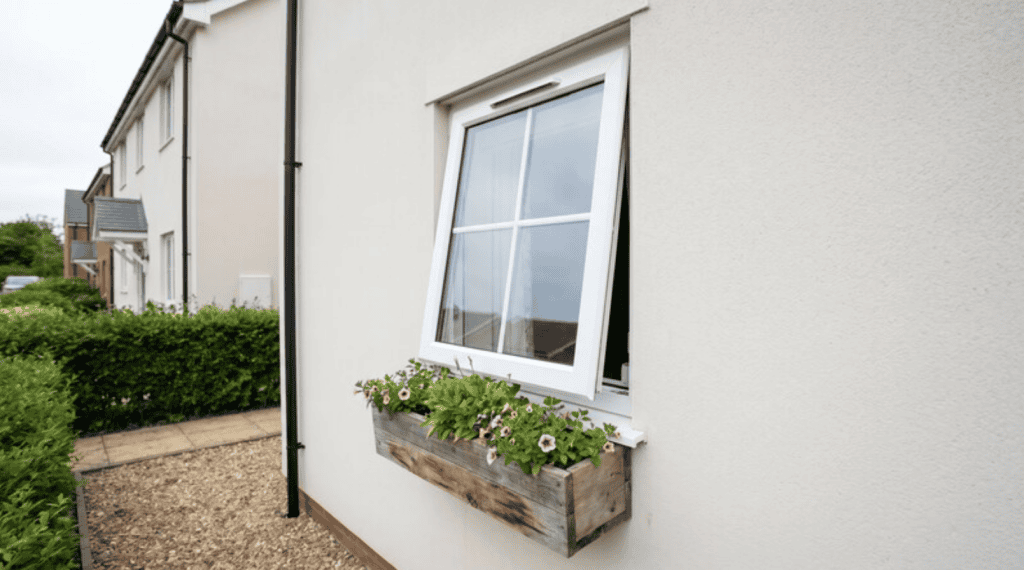
Glass coatings help with thermal insulation, glare control, and durability are invisible and feel no different from plain glass.
This guide covers the different types of coatings used in modern windows and doors, how they are applied, and what they are there for.
How coatings are applied to glass – Guide by double glazing professionals
Float glass comes off the production line as a flat, clear, uncoated pane, and coatings are applied at one of two stages depending on the type.
Hard coatings
Hard coat coatings are fused into the glass while it’s still molten during manufacture.
A metal oxide bonds chemically to the glass surface and becomes part of its structure.
Hard coat can sit on an exposed surface without protection, because the coating is durable enough to withstand handling and weathering.
Soft coatings
Soft coat coatings use a process called sputter deposition. This is where metallic layers are deposited at atomic thickness onto the surface of the glass inside a vacuum chamber during the manufacturing process.
Soft coat delivers better thermal performance than hard coat, but must be sealed inside a glazing unit to protect it.
Coating position and performance
Which surface a coating sits on determines how it manages heat transfer, and the numbering runs from outside to inside across the panes of glass.
The position assigned in the glazing specification is part of how the coating is designed to behave.
Low-E coatings and thermal insulation
Every window from The Advanced Group comes with low-emissivity coatings (low-e), regardless of whether they are double glazed and triple glazing units.
The coating reflects infrared heat back into the room, so less heat escapes through the glass than with uncoated units.
Uncoated glass radiates thermal energy readily.
A warm room loses heat as infrared radiation escapes through the pane toward the colder outer air, and there’s nothing in the material itself to stop it.
A low-e coating is designed to reflect heat back toward the room interior and reduce heat transfer through the glass.
Visible light and infrared operate at different wavelengths, so the coating doesn’t noticeably reduce the light coming through.
Solar control coating and heat gain
Solar control coating is designed to reduce heat gain by limiting how much solar energy enters through the glass.
It works by reflecting a portion of incoming solar radiation before it can warm the interior. This cuts down the amount of solar energy that passes through the glazing.
The coating typically sits on one of the outer panes. Because some radiation is reflected back, less solar energy enters the glazed area. At higher performance levels, less natural light comes through too, and the glass takes on a slightly reflective appearance from outside.
South-facing conservatories prone to summer overheating get the most practical benefit from solar control glass. Architectural and commercial glazing also benefit, particularly where cooling systems would otherwise have to compensate for high solar heat gain.
Heat retention across the heating season matters more than summer cooling for the typical Scottish home. So for most domestic properties in Scotland, a standard low-E specification is the better fit.
But the right specification ultimately depends on two things.
How much of the property’s glass faces direct sun, and how much heat the space needs to keep out.
Self-cleaning coatings
Photocatalytic self-cleaning coatings are applied to the outer glass surface and react with UV from the sun to break down organic dirt on contact.
The coating is also hydrophilic, so rather than forming droplets, rainwater sheets evenly across the glass surface and carries loosened material away.
Self-cleaning glass extends the intervals between manual cleans considerably. For conservatory roof panels, roof lights, and high-level windows where access is awkward, this is a fantastic solution.
In Scotland, where rain arrives consistently enough to keep the hydrophilic effect active, photocatalytic self-cleaning glass performs reliably.
Your window’s rubber seals and gaskets will still need periodic inspections and maintenance, but the glass itself will be better at self-cleaning.
Laminated glass and acoustic glazing
Laminated glass uses a plastic interlayer bonded between panes of glass during manufacture.
The laminate is part of the glass structure itself, so laminated glass holds together when it breaks rather than shattering.
Sound travels through solid materials by vibration. The plastic interlayer in laminated glass disrupts the resonance that carries noise through glass panels.
Acoustic glazing often pairs laminated glass with asymmetric glass thicknesses on the inner and outer panes.
The difference in thickness interrupts low-frequency resonance from traffic and road noise more effectively than uniform panes do.
Standard double glazing handles higher-frequency sounds well, but lower-frequency noise from lorries or railway lines needs a more deliberate acoustic specification to reduce properly.
The laminate also absorbs a high proportion of UV rays, so carpets, upholstery, and timber floors near laminated windows fade more slowly than they would through standard glass.
UV protection is a practical secondary benefit rather than the primary reason to specify laminated glass, but it adds long-term value to a high-performance glazing system.
Book a free home survey with The Advanced Group
Glass technology in modern windows is now lightyears more advanced than older units installed in the 90s.
Our team at The Advanced Group have been staying on top of the latest innovations to provide our customers with the best options on the market.
If you want to know whether your current windows are still performing well, or you’re planning a replacement and want to see what the current range offers, our team will be more than happy to walk through the specifications during a free home survey. We will also guide you through trickle vents and why they are important with new regulations.
We supply modern, energy-efficient windows and doors acoss Scotland, all backed by a 15-year guarantee and available on 0% finance.
Call our team today, or fill in an enquiry online to arrange your free survey.
